
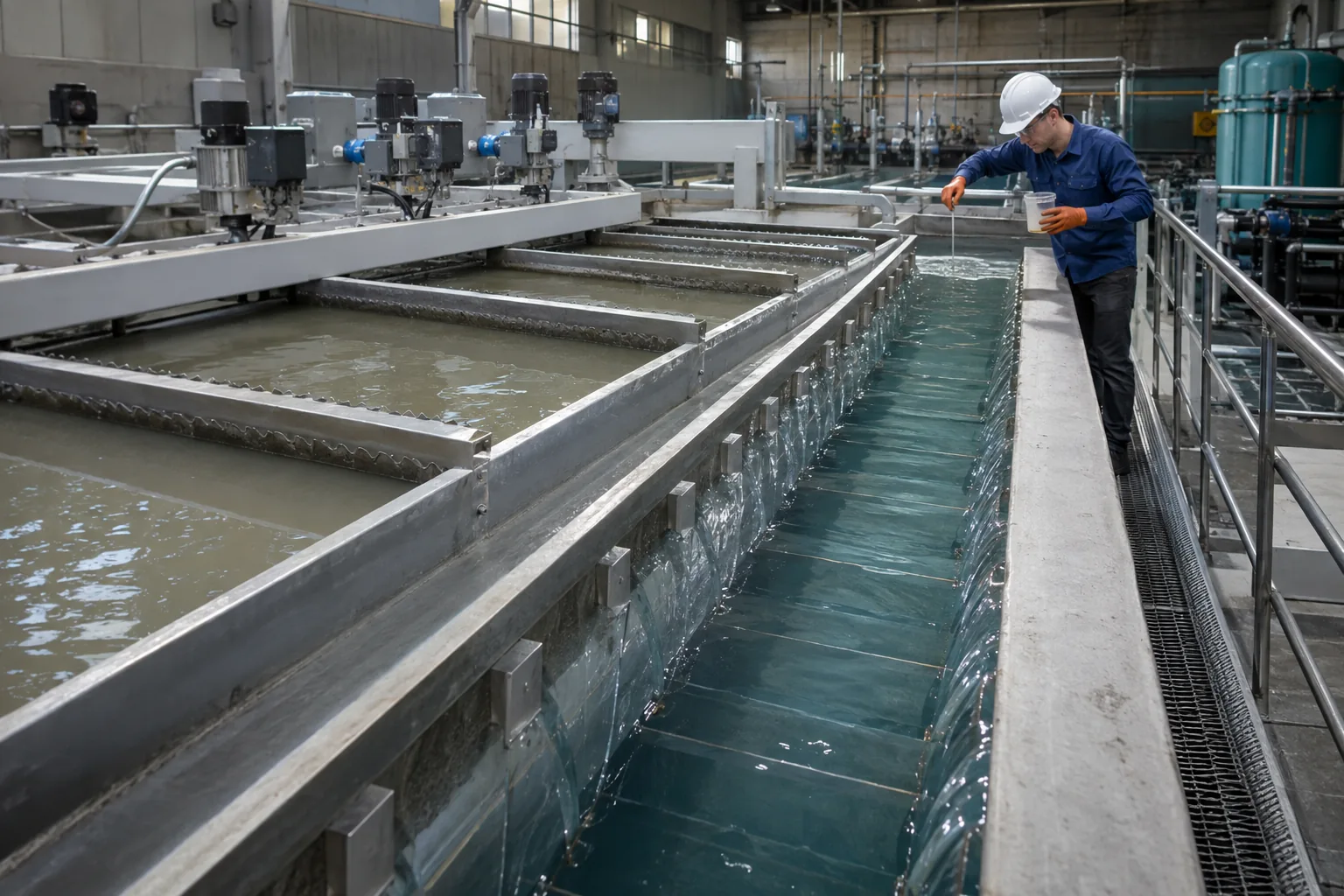
Describe the treatment sequence
Identify the feed source, upstream pH adjustment or coagulant, addition points and the DAF duty. State the current separation limitation and required liquid and float outcomes. Do not assume that a product selected for another separator transfers unchanged.
Keep coagulation and polymer screening as distinct questions where possible. Changing upstream treatment and polymer simultaneously can make a favorable result impossible to attribute to either proposal.
Use a relevant screening endpoint
Compare candidates with identified feed, preparation and dose units. Record the method used to assess flotation response and its limitations. A settling cylinder can provide observations, but it cannot by itself demonstrate performance in the installed flotation system.
Preserve clarified-water quality and float handling alongside capture. Large visible flocs are not enough if they fail to produce the required operating result. Use each proposed code’s preparation instructions before interpreting a chemistry difference.
Translate qualified performance into supply
Advance a promising candidate through a bounded equipment comparison under plant controls. Record feed and settings, actual consumption and the conditions that stop the trial. Avoid presenting an isolated observation as a guaranteed improvement in throughput.
Use the application brief and the trial handover to retain the accepted code and operating conditions. Confirm packaging, preparation capacity and documents for the commercial proposal. Neither the DAF label nor the polymer family alone establishes the right ionic type or purchasing quantity.
Keep these purchase records
| Decision | Evidence to retain |
|---|---|
| Sequence | Feed and upstream conditioning remain part of the defined flotation comparison. |
| Endpoint | Liquid quality, capture and float handling are assessed for the actual duty. |
| Supply record | Code, consumption and bounded equipment evidence justify the commercial proposal. |